BADIs
  • Who?
  • Why?
  • What?
  • When?
  • Where?
  • —
  • Links
  • News

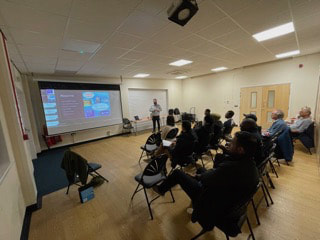
Welcome Chris Bensted, telling us about The Theory Test ... but much more

6/3/2024

 
Picture
Chris told us he'd spent 10yr in retail, then worked initially for BSM when becoming an ADI 15 years ago.  His background is in NLP and hypnotherapy, likes working 1-to-1 but is "not a people person".  He met Carly Brookfield (new at the DIA, and thoroughly recommends her support in tricky industry matters), soon finding himself in meetings with DVSA.  He formed the first Facebook ADI group, which now reaches 25% of ADIs.  Chris describes himself as a natural networker, with a conversational style (before CCL was the recognised term), "loves new stuff" where "different is better than good", using poetry, song, and stories to aid his communication.
The 2019 pandemic cause him to jointly set up "The DITC", based on the NHS's 'Swiss cheese model' for creating a resource that could keep ADIs going in an unknown future.  The "ADI walkback", nationally promoting better ADI mental and physical health, is their latest idea.  All Chris's work is in the driving industry, but now extends beyond the UK (via https://www.bni.com/).
Chris then talked about the theory test, and what WE FORGET to teach. For a start, the test is not about "revising"; it's understanding and remembering to apply stuff. That 'stuff' concerns (a) YOU driving (b) in a CAR, and that (c) we drive on the left, (d) overtake on the right, and (e) move clockwise. These are 'the unspoken default' or rules, to which there will be exceptions (usually, that “different is dangerous”). Get this and an average 60-80% nominal test mark rises to 65-90%.
For non-English speakers, he recommended Mike Warner’s “deaf pack” and BSLtheorytest.co.uk (where every test question shows a picture).  DVSA's use of English is specific to driving as a technical skill so Chris is currently working on a glossary to make it clear learners know what's meant by a sign, instructor, or in a test (e.g. 'road' is the sideways space “kerb to kerb”; lane is that space but narrower, “paint to paint”).
Picture
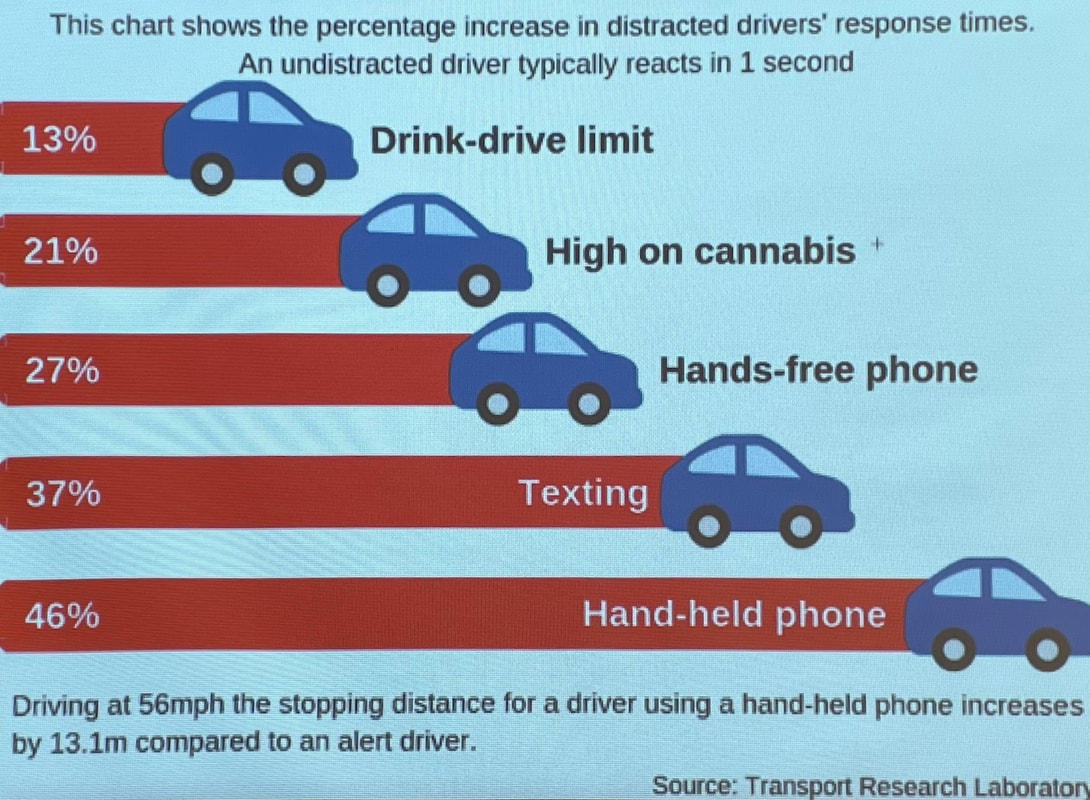
Often, a learner's problems in the Hazard Perception Test are solved by clicking more: whenever something that COULD move is seen.  And finally, everyone should know that passing a test simply means "I’ve met the minimum standard required".  We ended with the surprising picture of 'relative incapacity' between phones and intoxication ... and how societal attitudes [can] change.

Comments are closed.

© Birm. Approved Driving Instructors 2025
  • Who?
  • Why?
  • What?
  • When?
  • Where?
  • —
  • Links
  • News